
The rocky road with interest rates

Interest rates are powerful pedals used by central banks around the world to prevent economies drifting into high-inflation or recession. Growth slowing? Unemployment rising? Simply lower the interest rate, providing cheaper borrowing costs, encouraging investment into jobs, and watch as the economy picks up speed. However, accelerate too fast and you might breach the inflationary ‘speed’ limits set by each bank, so hiking interest rates acts as the brake.
Central banks, like the US Federal Reserve, European Central Bank (ECB) and Bank of England (BoE) sit in driver's seat, attempting to modulate the speed of the economy. Unfortunately, the decision to increase or decrease rates is not as simple as one might think.
For example, the Bank of England finds itself in a difficult situation where the UK economy is at a near standstill, but inflation remains high - a situation referred to as stagflation. Any interest rate decisions to alleviate one problem, worsens the other.
In the US, interest rates have remained at an elevated 4.25 - 4.50% [1] range since the start of 2025. The Fed has been concerned about cost-driven inflation due to the tariff policies imposed by Trump. In August, this inflation figure hit a seven-month high at 2.9%.
As a result, Powell has shown reluctance to cut rates, much to the vexation of Trump who believes the high rates are speed bumps on the road to growth. So much so, that Trump has threatened to take control by removing any ‘cautious’ drivers in the FOMC, first with threats directed at Powell, and more recently with an immediate attack on Governor Lisa Cook [2].
Powell has withstood Trump’s initial pressures, but a new issue is on the radar: a weakening labour market. In August, only 22,000 job were added in the US, as unemployment rates crept to the highest level since 2021 [3]. Powell has conceded that this may be a greater issue than that of inflation, indicating intentions to cut rates by 25 basis points [4].
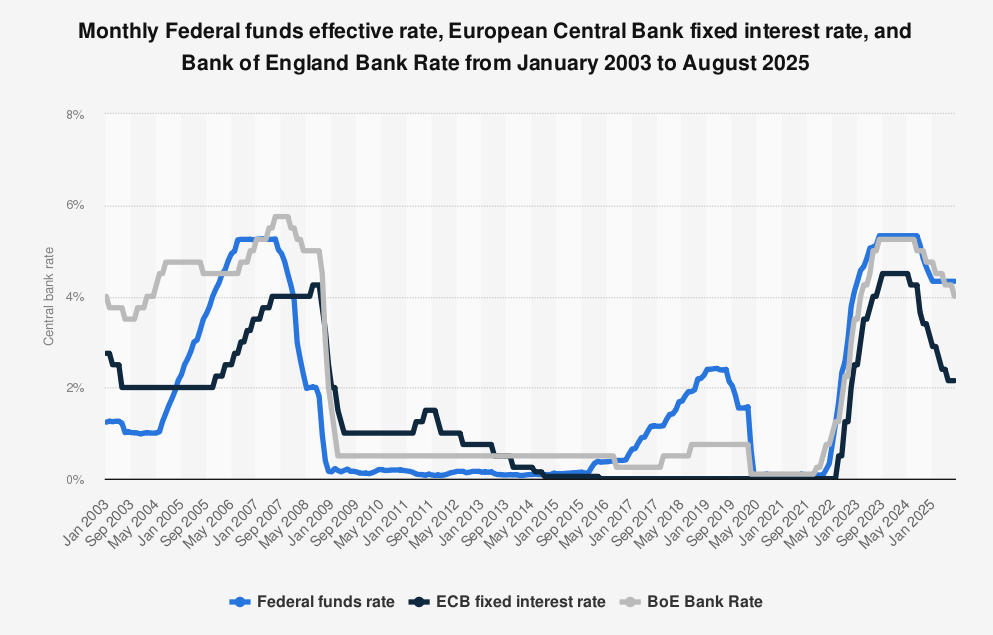
Monthly central bank interest rates in the U.S., EU, and the UK 2003-2025 [5]
The UK and US face differing economic situations, but historically, we have seen their rates correlate closely. This has been attributed to the dollar’s influence on financial markets and close ties between the UK and US, leading to the BoE following in the Fed’s tracks.
Through all this fog, it can be quite confusing for investors to know what to expect. Luckily, a handy tool for this is FedWatch. The tool displays the current probabilities of interest rate movements across a range of time periods.
For example, following the September 17th FOMC meeting, FedWatch predicts a 88% probability of a 25 basis point rate cut [6]. Looking further to October, predictions for further cuts into the 3.75-4.00% band are at 70.5%.
Across the Atlantic, this will mean cheaper mortgages and loans although savers will earn less on their deposits and bonds. I wonder if this will spur further shifts into the already teetering equity market?
Back at home, the BoE has adopted a more cautious approach to cuts, so savers can continue to enjoy better returns and yields, while policymakers hope this measure can curb inflation without damaging growth even more. Make sure to keep an eye on FedWatch to stay informed on this topic.
So for now, cruise control is off, and all eyes are on the road ahead.
Arcturus Wealth Management
Friday 12 September 2025
[1] https://tradingeconomics.com/united-states/interest-rate
[2] https://www.bbc.co.uk/news/articles/cx275n8gx0ro
[3] https://www.theguardian.com/business/2025/sep/05/us-jobs-report-august-tariffs
[3] https://www.ft.com/content/aa226632-ec28-4068-a465-e7ad8d603964
[4] https://www.statista.com/statistics/1470953/monthy-fed-funds-ecb-boe-interest-rates/
[5] https://www.cmegroup.com/markets/interest-rates/cme-fedwatch-tool.html